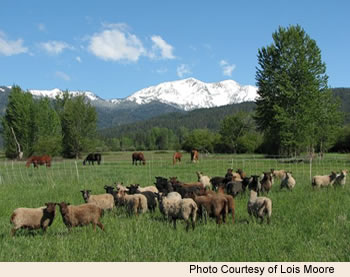
Breed Standard
SHETLAND SHEEP STANDARD
Description and Scale of Points Score – 100
Reproduced from the Shetland Flock Book Society
Bye-Laws & Regulations
Objects & Standard of the Society 1927
Adopted by NASSA 03/2000
| General character and appearance | (Horned or Hornless) | 9 |
| Head | Good width between ears, tapering rapidly to base of nose, which should be broad and with little taper to the muzzle, hollow between cheeks and nose well marked | 9 |
| Face | Medium length of face from eyes to muzzle, nose prominent but not Roman, small mouth | 5 |
| Eyes | Full, bright, and active look | 3 |
| Ears | Fine, medium size, set well back, carried slightly above the horizontal | 4 |
| Neck | Full, tapers into a fairly broad chest | 4 |
| Shoulders | Well set, top level with back | 6 |
| Chest | Medium width and deep | 5 |
| Back | Level, with as much width as possible | 9 |
| Ribs | Well sprung and well ribbed up | 4 |
| Rump | Good width, with well turned rounded hips | 5 |
| Tail | Fluke tail. Wool at root forming the broad rounded part, and tapering suddenly to barely covered fine point. This is a strong character, and any crossing is easily made out by it. Length varies according to the size of sheep, rarely exceeds six inches, or thereby | 9 |
| Legs of Mutton | Light, but very fine in quality | 4 |
| Skin | Varies according to colour of wool. In white no blue or black colouring | 2 |
| Wool | Extra fine and soft texture, longish, wavy, and well closed. Wool on forehead and poll tapering into neck, likewise wool on cheeks. Colors: white, moorit (from reddish to fawn), greys and black. Markings include: Mirkface (brownish spots on face), Katmoget (dark under parts from muzzle to tail and legs), Gulmoget (light underparts), Blaget and Flecket. | 20 |
| Carriage | Alert and nimble, with a smart active gait | 2 |
| Total | 100 | |
Disqualifications
- Long heavy tail, broad to point
- Bad wool, coarse and open
- Very coarse wool on breeches
- Deformities of jaws
- Undersized animals
- Defective coloured or badly shaped animals as sires
- White hairs in moorit and black, and dark hairs in white wool
NASSA Disclaimer:
* Note: The 1927 Shetland Flock Book Society standard was developed for the original inspection of sheep for registration by the Society. The standard includes seven specific faults that were considered serious enough to disqualify sheep from registrations. While these disqualifications are still part of the Standard, NASSA does not have an inspection system and does not disqualify purebred Shetland sheep from registration. However, NASSA recommends that breeders take into consideration these disqualification faults when evaluating Shetland sheep for breeding purposes and for registration. Note also that the Shetland Flock Book Society no longer exists having been succeeded by the Shetland Flock Book Trust.
Revised September 2014
43,853 views